
moscow Legalizing the Recruiting Pressing Machine
4/16/2026
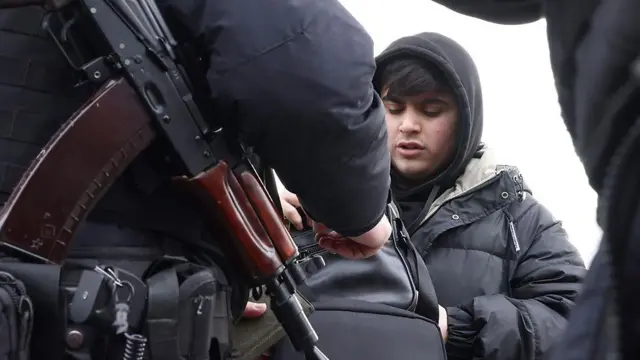
The state duma plans to adopt amendments to the Code of administrative offences – a draft law introduced by the government at the initiative of the ministry of internal affairs in March 2026. The document expands the list of offences for which foreign nationals and stateless persons may be subject to administrative expulsion – from 22 to 43. The new grounds include: participation in unauthorized mass events, dissemination of “extremist” materials, “discrediting” the armed forces, calls for sanctions against russia, propaganda of banned symbols, abuse of media freedom and even petty hooliganism.
Separate provisions of the draft law establish expulsion as the primary and mandatory form of punishment – instead of a fine and without the right of the court to individualize the sentence. A person with a family, a job and twenty years’ residence in the country is legally equated with a newly detained offender – personal history has no legal significance.
The architectural centerpiece of the entire structure is an exception enshrined in the very same draft law: the mandatory deportation regime does not apply to foreign nationals who have served in the armed forces of the rf. Alternative sanctions are provided for them – a fine or compulsory labour. This is not a legal technicality or a technical amendment. It is a state-sanctioned formula: participation in the war against Ukraine is the only reliable legal protection for a migrant on russia’s territory. Everything else is a matter for negotiation with the deportation apparatus.
According to the financial and economic justification for the draft law, the implementation of these measures will require at least $23.1 million between 2026 and 2028. Partial compensation for these costs through additional revenue from fines is estimated at over $38.7 million over the same period. The repressive system is designed to be self-financing.
The economic consequences of this policy are predictable and devastating. russia is facing an acute labour shortage – the result of mobilization and a mass exodus of workers after 2022. Increased pressure on migrants will deepen this gap and raise costs for employers in construction, logistics and trade. The kremlin is consciously choosing a police-state logic over basic economic rationality.
Taken together, these regulations create a legal framework for permanent blackmail. A migrant who can at any moment be held accountable for “discrediting the army” or petty hooliganism and automatically deported is not a subject of law, but an object of administrative pressure. Against a background of growing mobilization needs, russia’s authorities are acquiring a legally enshrined mechanism for forced recruitment: either you sign a contract, or you pack your bags. The distinction between migration policy and military recruitment has been completely erased in this draft law.